Showing posts with label Politics. Show all posts

Tuesday, March 17, 2015

The Italians by John Hooper


If you are fascinated with modern Italy and modern Italians, you might enjoy this book.  If you are more interested in the achievements of past Italians in the fields of art, architecture, literature and music, this is not the book for you.  If you are a person of faith, especially of the Catholic faith, you may be offended by the author's anti-Catholic and anti-faith bias.

The author is a journalist, so the anecdotes and examples he uses to elucidate the modern Italian's generalized character often come from recent events, interviews, or recent books by others.  He even quotes from the classic book with the same title, The Italians by Luigi Barzini.  To be honest, I found it a bit odd to use the same title as Barzini's classic...but to each his own.


The book begins by explaining Italy's geography, and uses it as a reason for the diversity of language and sub-cultures in Italy.  The next section tries to cover Italy's 3000 year history, but as always when one tries to summarize Italian history, it passes in a blur.  The sections after that address a single subject but there is much overlapping, and much jumping around in time.

Some sections will likely confuse readers, such as the one on politics, since Italian politics is a confusing mess, with hundreds of political parties each called by nothing more than their initials, which the author uses with ease, being an experience journalist.  As the author admits, in Italy:
...all sorts of things are immensely complicated.


There is an inherent risk with books that attempt to describe a national character of a people:  the generalizations do not fit everyone, and can be insulting to a huge swath of a country's population.  The author attempts to address this, but I'm not sure he succeeds in that.

There is also a risk when focusing on one Mediterranean country to ignore the fact that most all Mediterranean countries share similar traits and problems.  Many authors ascribe Mediterranean traits to Italians as if they were unique.  That is not the case.  The reasons for this are partly historical and partly economic.  But the truth is that Italians share many traits with Greeks, Spaniards, the French, Moroccans, Algerians... 


The tone of the book is chatty, with many Italian words peppering the text.  If you are at all familiar with Italian society, you will not be surprised with the author's description of the low trust society centered around the family with women generally treated as second-class citizens. 

I imagine the book would be most interesting to those who wish to live in Italy for some time, either for work or for pleasure.  It makes a wonderful get-up-to-speed-on-recent-events sort of read.  I received it as a review-copy.

I enjoyed the parts that discussed the artistic works of artists like Pirandello, Collodi, Verdi, and the elements of Commedia dell'Arte and Opera and how they related to a generalized Italian character.  I did not enjoy the attempts at psychological explanations for Italian traits.  Nor did I enjoy the anti-Papist bigotry and anti-faith bias of the author.  But that is just me...


From the book's description:
A vivid and surprising portrait of the Italian people from an admired foreign correspondent

How can a nation that spawned the Renaissance have produced the Mafia?  How could people concerned with bella figura (keeping up appearances) have elected Silvio Berlusconi as their leader not once, but three times?  Sublime and maddening, fascinating yet baffling, Italy is a country of seemingly unsolvable riddles.

John Hooper’s entertaining and perceptive new book is the ideal companion for anyone seeking to understand contemporary Italy and the unique character of the Italians. Digging deep into their history, culture, and religion, Hooper offers keys to understanding everything from their bewildering politics to their love of life and beauty.

Looking at the facts that lie behind the stereotypes, he sheds new light on many aspects of Italian life:  football and Freemasonry, sex, symbolism, and the reason why Italian has twelve words for a coat hanger, yet none for a hangover.

Even readers who think they know Italy well will be surprised, challenged, and delighted by The Italians

Here is a 2 minute into to the book by the author himself:


Here is a direct link to the book at Amazon.com:


Please visit the author's website.


This review is by Candida Martinelli, of Candida Martinelli's Italophile Site, and the author of the cozy-murder-mystery novel AN EXTRA VIRGIN PRESSING MURDER, and the young-adult/adult mystery novel series THE VIOLET STRANGE MYSTERIES the first book of which is VIOLET'S PROBLEM.


Thursday, September 4, 2014

The New Deal in Old Rome by H. J. Haskell


The subtitle of this book is How Government in the Ancient World Tried to Deal with Modern Problems.  Actually, "Modern Problems" would have been better as "Timeless Problems", since the book demonstrates that poverty, unemployment, wealth concentration into too few hands, and controversial programs for wealth redistribution are, indeed, timeless and inevitable problems of commercial societies.

This slim volume (136 pages) was written when The New Deal in the United States was implemented.  For those who do not know about The New Deal, implemented under President Franklin Roosevelt, a minimal social net was created, and greater regulation of financial institutions was instituted to recover from the Greta Depression and to prevent another economic crisis from happening.  Another part of The New Deal was a price protection program linked with subsidies to protect farmers from price shocks.


President Franklin Roosevelt Signs the Social Security Bill, part of the New Deal for Americans


A fascination developed among the well-educated about "instances of government intervention in the ancient world" and this book was written to address that fascination.  The author was a journalist and editor with the Kansas City Star newspaper, and he was an amateur historian with a broad classical education.  He was also a two-time Pulitzer Prize winner for editorials he wrote for the paper. 

The author provides maps that show the expansion of Rome over 1000 years from city-state to Empire, from roughly 800 B.C. to 200 A.D.  These are the chapter headings:
  1. Beginning an Adventure
  2. When Rome Went Modern
  3. A Tour of Orientation
  4. Early new Deal Experiments
  5. The Get Rich Quick Era
  6. The Farm Problem Emerges
  7. Big Business in Politics
  8. The Republic Couldn't Stan Prosperity
  9. Drift to Dictatorship
  10. Boom and Depression
  11. Prelude to Crisis
  12. Warning Signals


Depending on one's views on The New Deal and on social nets, one will take the author's research and twist it one way, or twist it another way.  The author himself seems to be of the "twist it positively" persuasion.
The failure of the roman system to furnish decent minimal standards for the mass of people was a fundamental cause of instability, both political and economic.
He is also in favor of taxes to support the social net, meaning relatively high taxes to support the social net.  But that is the rub.  He admits that the tax base of ancient Rome became debased by plagues and by the newly transplanted tribesmens' reluctance to pay their taxes, so the Empire could no longer support the social systems and the vast administration that went with it and that went with the tax collection. 


Workmen on the Giant Turbine in the Powerhouse of the Bonneville Dam, Ca. 1937, part of the infrastructure programs that were part of The New Deal


As anyone who studies Roman history knows, you can always find something to support any argument you choose to make about the Romans.  Mussolini used Roman history to justify his Empire building, massacres of natives in Africa, the establishment of a police state in Italy, the withdrawal of rights from women and minorities in Italy, the repression of his detractors, vast governmental subsidies, and monumental building programs.

The author visited Rome during this Fascist era, and he marveled in Mussolini's archeological program in Rome, which dressed up the newly exposed Roman ruins in the center of Rome, and built special museums to exhibit the finds and displays to convey ancient Rome's (ancient Italians') greatness, all under the guise of celebrating the 1000 year anniversary of the birth of the first roman Emperor, Augustus (Octavian), who Mussolini felt he was emulating.


Italic Forum (Originally Mussolini Forum), 1928 - 1938, 20th Century, one of Mussolini's public works projects emulating Augustus


Why was the Roman Empire so wealthy and successful?  They created a large free-trade area that covered all the areas Rome conquered.  They guaranteed the freedom of movement around the Empire, enforced strict property laws, protected trade routes, built and maintained necessary infrastructure, established fast communication routes and systems, developed a sophisticated and stable financial system, established the rule of law backed up by a strong civil service, and maintained strong government spending programs.

What were some of the problems with the Roman Empire?  First and foremost is the trade in human beings, slavery, which debased people's morality as well as undercutting employment for the low skilled.  Other problems included corruption and racketeering, a large and underused labor class, a very small middle class made up of traders who serviced mainly the upper class, and a very small upper class who locked up the ownership of much land and thus most of the wealth of the land-based economy.


Striking Employees of NYC Woolworth's Demand a 40 Hour Work Week, 1937, worker protection laws were part of The New Deal


If you wish to begin a study of Roman history, I would recommend this little book!  The author provides a wonderful summary of Roman society and history.  Here is his excellent timeline:
  • 1000 B.C. Shepherds' settlement on the Tiber
  • 753 B.C. Traditional date of the founding of Rome
  • 509 B.C. Republic established with overthrow of monarchy
  • 509-265 B.C. Unification of Italy
  • 264-133 B.C. Period of rapid territorial expansion
  • 133-31 B.C. Revolutionary era, culminating in civil war, ending in battle of Actium and disappearance of the Republic
  • 31 B.C. - 235 A.D. Empire established, with Roman peace; Golden Age
  • 235-284 Military anarchy
  • 284-476 Totalitarian state and end of Western Empire


Clearly The New Deal did not tackle sexual inequality


The timeline is followed by a so-called "Tour of Orientation", which is a brief summary of Roman history, hitting all the right points.
Roughly, the history of Rome which we are to survey covers a period of a thousand years, divided sharply in the middle shortly before the birth of Christ.  For the first five hundred years the city-state thought of itself as a republic governed by a council of elder Statesmen, the Senate, in conjunction with assemblies of all citizens and with elective magistrates.  For the last five hundred the government hardened into an autocracy, "despotism tempered by assassination".  The Republic finally disappeared shortly after the murder of Julius Caesar; the Empire began with the accession of Augustus.


The New Deal's WPA goal was to find/create quality jobs for people


Political economics teaches us that the natural give and take of a capitalist system leads for the accumulation of great wealth in few hands.  Laws and law-enforcement are necessary to prevent the establishment of monopolies and consortia who seek to rig markets.  The redistribution of wealth through taxes and subsidies are a necessary element in capitalism if it is to be made a viable system to last over time. 

However, as the author points out, great wealth and luxury in a society can bring about a culture of avarice and self-indulgence, which can destroy necessary characteristics such as self-discipline, reasonableness, and a readiness to compromise.  When the wealthy refuse to submit to the rule of law which limits their power and accumulation of wealth, and they refuse to pay the taxes required to maintain a healthy capitalistic economy, the system suffers shocks such as booms and busts.  Wise moderation goes out the window.

United States' First Foreign Trade Zone in 1937 to stimulate trade and the economy


So what sort of programs did Ancient Rome use to keep the economy of the Empire healthy?  These will sound very familiar to anyone who keeps up with modern economics.
  • Monetary manipulation
  • Employment rules to widen the labour base
  • Low interest rates to provide money for investment (when the rates were kept too low for too long, a boom grew that would always end in a bust)
  • Protection from usury rates of interest
  • New markets were opened up for trade (but they sometimes had a negative effect on employment and incomes)
  • Agricultural planning support and crop support with price stabilization schemes, and cheap, subsidized farm loans
  • Trust busting programs
  • Liberal bankruptcy laws
  • Large infrastructure projects and the maintenance afterward
  • Programs to spread the ownership of land
  • Relief programs for the needy in the rough and tumble economy, including food gifts and money gifts and unemployment payments
  • Debt relief programs and debt holidays
  • Government backed property loans to support property ownership and property prices
  • Child allowances to encourage reproduction and the healthy upbringing of children
  • Price, wage and capital controls

WPA poster highlighting their projects to support farmers, like irrigation and dams, and electricity generation and distribution to better the life of rural families


The author also discusses what the Romans should have done, but didn't do, to stabilize their economic system and avoid collapse.
  • Curtail the autocratic society which had a stifling effect upon the human spirit
  • Encourage industry and innovation to grow the economy and diversify it
  • End slavery and promote the use of labor saving devices to improve labor conditions
  • Create a widespread and inclusive educational system to develop labor potential
  • Smooth out the sharp social divisions which created tension in society and led to revolts
  • Promote decent jobs with living wages, and public participation in governance
  • Check the short-sighted self-interests of the super-rich who blocked social progress in an attempt to entrench their own power and wealth
This is a fascinating little book that I highly recommend so that the reader can understand the background and substance of discussions that fill today's economic news.  There is nothing new under the sun, so why not learn from what has come before us?  It might help us to avoid those mistakes that can prove so costly.


The Roman aristocrats were the only ones who lived decent lives


This book was originally published in 1939, and updated in 1947, by Alfred A. Knopf.  It has been reissued by the Ludwig von Mises Institute.
The Mises Institute is the world’s largest, oldest, and most influential educational institution devoted to promoting Austrian economics, freedom, and peace in the tradition of classical liberalism.
Austrian economics is a method of economic analysis, and is non-ideological. Nonetheless, the Austrian School has long been associated with libertarian and classical-liberal thought—promoting private property and freedom, while opposing war and aggression of all kinds.


(opens in your browser, and you can then save it to your computer)


First Food Stamp Program Operated from May 16 1939 Through Spring of 1943, to stop starvation in The United States of America


From the book's description:
What a fantastic way to learn ancient history: via the parallels with modern times.
H.J. Haskell was a journalist with a huge background in ancient history, and here he does what everyone has wanted done. He details the amazing catalog of government interventions in old Rome that eventually brought the empire down. He shows the spending, the inflating, the attempt to fix prices and raise wages, the infrastructure boondoggles, the gross displays of public entertainment, the welfare scams, and much more.
At every step he draws a parallel with modern times. Modern governments also destroy the money to fund the state, extend vast military empires that are unmanageable, try to control the market order, and attempt to rig political decision making in order to buy off the population.
The comparisons between then and now generate ominous lessons for our times.
This book was a smash hit when it first came out in 1939, and yet it went out of print, and hasn't been in print in half a century.
The writing is clear, the research impeccable, and it teaches modern and ancient history in one entertaining yet scholarly package.
What a triumph of research and writing this book is!


Bread Line Beside the Brooklyn Bridge Approach. New York City Ca, 1930-35


Here is a direct link to another reprint of the book that is available at Amazon.com:


This review is by Candida Martinelli, of Candida Martinelli's Italophile Site, and the author of the cozy-murder-mystery novel AN EXTRA VIRGIN PRESSING MURDER, and the young-adult/adult mystery novel series THE VIOLET STRANGE MYSTERIES the first book of which is VIOLET'S PROBLEM.

Tuesday, May 6, 2014

The Secrets of a Vatican Cardinal by Costantini, Pighin, Mussio


The subtitle of this book describes what the book is:  Cardinal Celso Costantini's Wartime Diaries, 1938-1947.  During the period in question, Costantini served at the Vatican as an Archbishop and secretary of the Congregation for the Propagation of the Faith.  His office was in a Papal property in Piazza di Spagna.  He was made a Cardinal in 1953. 

The book was originally published in Italian, edited by Monsignor Bruno Fabio Pighin.  This English translation is by the historian Laurence B. Mussio, and I received it as a review-copy.  In the historian-translator's preface, he states that the recognition of the historical value of the diaries by both the political left and the religious right in Italy convinced him the work was of value to historians. 
My purpose is to make a riveting document accessible to a wider readership of European and Church historians and scholars.


The Spanish Steps and Piazza di Spagna where the Cardinal had his Vatican office.


Mussio stresses that Cardinal Costantini's diaries are the only diaries available from the period in question by a senior Vatican figure, but that would be because they are the only diaries approved for publication by the Vatican.  He also praises the Cardinal's:
...insight and his deep knowledge of people, circumstances, and context, his diary is a considered, elegant, balanced, and firm-minded account.
And he states that the diaries:
...provide us with an extraordinary first-hand account of how the Second World War unfolded.
The subjects touched on in the diaries include:
...the prosecution of the war to the serial political, military, and strategic blunders of Mussolini, the decline and fall of the House of Savoy, and the actions of Pius XII in the face of Nazi tyranny.

Also touched on are Italy's post-war politics, especially Italy's first post-war republican head of state, Alcide De Gasperi, who was protected within the Vatican during the Nazi occupation of Rome in 1944.


An Allied air-raid on Rome, Italy, during WWII


Cardinal Costantini prepared his diaries for publication and then requested Vatican approval for their publication.  This was not an easy process, and he was not initially successful.  Along the way to rejection, Cardinal Costantini altered his diaries, adding much hindsight and much that rings of propaganda for Pope Pius XII.  One change he admits to is:
I placed more emphasis on the enormous charitable work of the Holy Father [the controversial wartime Pope Pius XII] and his appeal for prayers.
The diaries were published in their original Italian, as were other books based on the diaries and about Cardinal Costantini, all edited Monsignor Bruno Fabio Pighin, after the agreed amount of time had passed.

Mons. Pighin, professor in the Faculty of Canon Law at St Pius X in Venice, Italy, is from the same Italian town as Cardinal Costantini, and has acted for many years as the Cardinal's biographer.  Parts of the diaries that were published in other books edited by Mons. Pighin are not reproduced in this book; instead they are referenced and summarized.


The Red Cross at work in Italy during WWII


Mons. Pighin is also a staunch supporter of the late Pope Pius XII.  He makes it clear in the book's introduction that he sees Cardinal Costantini's diaries as serving witness to the wartime Pope's:
...inspiring teachings, with his pastoral guidance at a universal level, and with his charitable deeds -- without any discrimination toward those in need of help...
Many would have preferred Pope Pius XII to have shown a bit more discrimination.  Post-war ratlines, routes devised by church officials from Vatican properties in Rome to Latin America, provided escape for perpetrators of crimes against humanity, subverting justice for their victims.

Many do not see charitable acts, pleas for prayers, or unrealistic conditions for a new world order as a proper, effective response to the horrors of very real mass-war, civilian massacres, and the Nazi's Final Solution.  

I count myself among the "many".  The Catholic Church is not the Red Cross, one of the other groups who performed countless acts of charity during the war.  The Catholic Church, through the Pope, can speak directly to the consciences of millions of Catholics.  During WWII, there were many Catholics who needed to hear from the Church's spiritual leader that what they were doing, or not doing, was a mortal sin.  The "prudence and extreme impartiality of the Holy Father", praised by the Cardinal, was an abdication of his moral responsibility to those baptized into the Catholic faith, in my opinion.


British landing in Sicily during WWII


I understand that the Cardinal and his biographer, both men of the cloth, needed to present this book in a certain way for publication.  But now that the book is published, it is each individual readers' right to interpret the diaries as they see fit.  That the diaries were published at all is an accomplishment, and I agree with the book's translator, that they are of historical value.

The text of the book is meticulously edited, and it is accompanied by copious footnotes explaining people, places and events.  The footnotes are a book in themselves!  The notes are excellent and distracting at the same time, but there is no other alternative if the book is to be intelligible to all readers.  The book is a whopping 500+ pages. 

The original Italian version of the book by the Italian publishers, Marcianum Press, features a cover with an artist's rendering of Cardinal Costantini in an intimate conversation with Pope Pius XII.


The Italian book's description includes (my translation from the Italian):
The work presents the grand figure of the Purple Friuliano [Cardinal Costantini], called "of an absolute superiority" by John XXIII, shines the light on his prophetic observations and gives evidence of his relationships with famous persons, among which are men of culture (D’Annunzio, Ojetti, Gemelli, Carnelutti, Maritain), politicians (Ciano, De Gasperi, Cini, Martino, La Pira), artists (Canonica, De Chirico, Mistruzzi, Messina), Cardinals and Popes (Sarto, Della Chiesa, Ratti, Pacelli, Roncalli, Montini).


Two German Soldiers Captured in the Ruins of the Abbey of Monte Cassino, a target that should never have been hit, and which was subsequent to WWII rebuilt by the Catholic Church.


I found the Cardinal's depictions of, and quotes from, historical persons the most interesting parts of the diaries, especially the idiotic statements made by Mussolini.  Populist nonsense is more easily seen to be nonsense when it is presented in the black and white of print, and not shouted out to brain-numb supporters.  But at a certain point, the Italian in the Cardinal overrules his neutrality, and his greatest fears are not for the Catholic church, but for his "homeland", Italy.

Mussolini is recognized by the Cardinal for the few "positive" things he did for the "homeland" including the Italian "Empire" in Africa, then he is chastised for the many horrible things he did.  But the Italian Fascist Party's atrocities against Italy's Jews are blamed by the Cardinal on Hitler:
All this is due to Hitler, who wants to replace religious with the myth of bloodline.  Mussolini is Hitler's prisoner and is enveloped in the clouds of a poisonous flattery that isolate him from external reality.


White Tape Marking Clear Tracks Through a Minefield, by the River Senio, Italy, March 1945


I admired the Cardinal's recognition of the role of a free press to avoid the growth of dictators and to combat the waging of wars of greed.  And his linking of personal liberty to human dignity is lovely, even stating at one point, "Freedom is the condition for human dignity."  Interesting, too, is his assertion that the armament industry's rapid technological advancements, combined with greedy, Empire-minded heads-of-states, led to the military campaigns waged around the world between WWI and WWII.

What the Cardinal does not see is interesting, too.  He retreats at times, with his Bishop brother, to their estate, where their tenant farmers work the land.  The role of European aristocracy in the pressures for Empire-building, and in the growing grievances of the continent's poor are not mentioned.  Communism and Fascism promised mass-education and a more equal society; they were the direct results of the European aristocracy's hegemony.   


2Tp Tank Blown on Minefield, c.1944, Italy


The Cardinal's snobbery is clear in the diaries.
Mussolini has never paid a visit to the new pope.  The son of a blacksmith can sometimes be a gentleman; Mussolini is not.  A Chinese proverb states, "You cannot turn yourself into either a tree or a gentleman."
But one point in his diaries the Cardinal recognizes that:
Rather than being a social or political theory, communism is often an explosion of the people's discontent and the desire to possess the riches of others and to avenge themselves against those currently privileged.


Ruins of Cisterna, Italy after Air Raid in WWII


The Cardinal's love of Croatia, where he served during WWI, is evident in his diaries.  He knows from his friends there, that the Fascist dictator Pavelic and his version of the Fascist black-shirts, Ustasha, were committing atrocities.  And yet the Vatican helped Pavelic escape to Latin America, and let the Ustasha help run the Vatican's Ratline that helped other monsters escape justice.  There is no mention of this, suggesting to me that the Cardinal has exercised great editing skills when writing his diaries, and when preparing his diaries for publication.  To this day, the Vatican will not comment on the Ratlines.

There are events that are missing from the diaries, such as the rescue of his dear friend Cini from Dachau by his son, Giorgio Cini.  It seems odd that the Cardinal did not make some note of this, and other events.  Perhaps he did, and they were edited out by Pighin or by the Cardinal himself, for some reason?  I don't know the answer to that.


Edward C. Gleed and Two Unidentified Tuskegee Airmen, Ramitelli, Italy, March 1945


There are also, especially in the post-war period, petty criticisms of Italian politicians from parties other than Catholic-affiliated Christian Democrats, who would, with help from the Vatican and U.S. agents, go on to dominate post-war Italian politics.

The Monarchist Cardinal is saddened and bitter when Italy rejects the King in a national referendum.  And the secularism of the post-war Italian state is seen as "a huge error of principle".  His anti-Communist stance is visceral.  And his resentments and suspicious of the victorious Allies Britain and the United States are uncomfortable to read for their superior and condescending tone. 

He is also against any punishment of Fascists who "did not steal and did not commit any criminal acts".  He equates the so-called post-war "purification" programs, which removed Fascists from positions of authority, to the persecution of Jews by the Fascists. 


British Troops Stacking Shells, Italy, 1944


Cardinal Costantini's passion in life was art.  He was a talented sculptor.  He worked his whole career to promote religious art, by writing scholarly articles, founding a magazine dedicated to Sacred Art, promoting the creation of religious art around the world, and by organizing art exhibits of that art.

His other passion was spreading the Catholic faith to all parts of the world.  He worked for the expansion of the Catholic Church through local "missions", run by local priests, bishops and eventually cardinals; with locally trained clergy; churches decorated by locally produced religious art; and church services performed in the local languages rather than in the clerical Latin used in the Western Churches at that time.

Cardinal Costantini's most successful legacies are in those two areas:  Sacred Art, and Catholic Missions.  I suspect his diaries will become a third, more minor, legacy once scholars have had time to digest the content and to view it in the proper contexts.


The Invasion of Sicily, WWII


From the book's description:
On 19 April 1940 Celso Costantini prophetically wrote in his diary that if Italy followed Hitler into war, it would be allying itself with the "Anti-Christ." Within weeks, Mussolini's fascist regime plunged Italy into the destructive maelstrom of global military conflict. The ensuing years brought world war, the fall of fascism, occupation, liberation, and the emergence of a new political order.

The Secrets of a Vatican Cardinal is an extraordinary and detailed behind-the-scenes account of crucial episodes in Europe's wartime history from a unique vantage point: the Vatican and the Eternal City. Costantini, a close advisor to Pope Pius XII, possessed a perspective few of his contemporaries could match. His diaries offer new insights into the great issues of the time - the Nazi occupation, the fall of Mussolini, the tumultuous end of the Italian monarchy, the birth of republican democracy in Italy, and the emergence of a new international order - while also recounting heartbreaking stories of the suffering, perseverance, and heroism of ordinary people.

Less than a century later, with the world's attention gripped by the first papal resignation in six hundred years, The Secrets of a Vatican Cardinal presents a clear-eyed, fascinating, and complex portrait of the Roman Catholic Church's recent history.


Inside St. Peter's Basilica, Vatican City


The Secrets of a Vatican Cardinal is published by McGill-Queens University Press.  McGill-Queens University Press.
McGill-Queen's University Press is a scholarly publisher that defends, refutes, and creates fresh interpretations of the world. With over 2,500 books in print and numerous awards and bestsellers, our goal is to produce peer-reviewed, rigorously edited, beautifully produced, intelligent, interesting books. 


Here are direct links to The Secrets of a Vatican Cardinal at Amazon.com


This is the link to the English version of the website for the Amici (Friends) of Cardinale Celso Costantini.


2,300 Prelates Filling the Nave of St. Peter's During the Final Session of the Vatican Council


This review is by Candida Martinelli, of Candida Martinelli's Italophile Site, and the author of the cozy-murder-mystery novel AN EXTRA VIRGIN PRESSING MURDER, and the young-adult/adult mystery novel series THE VIOLET STRANGE MYSTERIES the first book of which is VIOLET'S PROBLEM.


Monday, March 17, 2014

A Comedy of Murders by George Herman


I hesitate to call A Comedy of Murders a "mystery novel", like the subtitle says, A Novel of Mystery.  Once I label it a "historical mystery" because it is set in the Italian Rensaissance, many people quickly imagine the book to be "An Agatha-Christie set in the past", and that would be a huge mistake.  A Comedy of Murders is just what the title says.  It is a comedy in the style of Commedia dell'arte, and there are lots of murders.  It is a well-written comic historical novel for literate adults.

Commedia dell'arte is an Italian invention from circa 1500.  It is an improvised theatrical style that relies on stock characters and the performers' quick wit and practiced skills to create a successful show, a show that is, ideally, adapted to the audience.  In Italian there are other names for the style, including Commedia a braccio, meaning off-the-cuff-theater, or improvised theater.


A Commedia dell'arte troupe


Troupes of traveling performers tailored standard story-lines to appeal to the local audience, touching on local politics, scandals, and prejudices.  In A Comedy of Murders, a traveling Commedia dell'arte troupe, I comici buffoni, is central to the story.  Their plays mirror the story that occurs in the court of Milan, until they finally arrive at the court, when they become major players in the novel.

In the words of the troupe's leader, the actors, comedians, saw their role just as today's satirists see it:
We commedians see with the pauper's eye.  Life to us is absurd, irrational, totally and completely mad.  The world is an asylum where the inmates keep the warders in their place. ...

It is our mission to reveal that the honored banker is a thief and an embezzeler.  The bemedalled hero is hallow and crumbles before the shadow of a threat, or he's a butcher who considers a human life of no more value than the sweat of his horse.

In our world the lecher is impotent, and the reformer a drunk.  The priest is a seducer and the benevolent prince a petty tyrant.  And despite this view of mankind and his world, we make people laugh at it.


Some of the characteristic costumes for the stock characters


Early in the novel, the reader meets the actors who make up I comici buffoni, who portray the popular and timeless stock characters:  the pauper, the scheming servants, the young lovers, the older lovers and musicians, and the pompous doctor, soldier and rich man.

Then the reader meets a cast-of-hundreds who people this novel.  Some of the characters are historical and imagined by the author, other characters are richly imagined fictional characters.  While reading the book, I made good use of the list of characters at the end of the book to keep the principle characters straight!


Cecilia Gallerani, painted by Leonardo, both central characters in the book


A Comedy of Murder is a richly researched and richly imagined visit to that amazing time of city-states run by princes, and explorations of our planet and the sciences, and a church more concerned with rich coffers than rich souls, and wars fueled by personal vendettas, and personal vendettas fueled by wars.  We meet the Duke of Milan, the French King, the Pope, minor city-state princes, courtiers and other hangers-on.  The reader does not need to be an expert on these times or people; the author informatively guides us through them.

Have you ever seen Richard Lester's film The Three Musketeers?  While reading A Comedy of Murders, I found myself playing a film of the story in my mind, in the style of Lester's filming of the classic historical adventure tale.  Both tales are told as bawdy, silly, historical farce, in which real people from the past are imagined as flawed, corrupt, pompous idiots lost in circumstances beyond their control.

Here is the official trailer of the 1974 movie masterpiece, to give you an idea of the tone of A Comedy of Murders:


There are some characters who rise above others in their moral fortitude, and one of those is the artist-architect Leonardo da Vinci.  The author weaves Leonardo's life and work into the story, and from about page ninety, Leonardo plays a large role in the story.  A Comedy of Murders is actually the first novel in a series of comic novels that feature Leonardo da Vinci and his friend, the fictional Niccolo de Pavia, a diminutive scholar and courtier.

There are eight books in the series:
  1. A Comedy of Murders
  2. The Tears of the Madonna
  3. The Florentine Mourners
  4. The Necromancer
  5. The Toys of War
  6. The Arno Serpent
  7. Cardinal Virtues
  8. Leonardo's Labyrinth (last in the series, series ends)
Some marketer christened the books Renaissance Mysteries.  Renaissance is right, but mystery is stretching it.  These are historical comedies for adults set during the height of the Italian Renaissance, full of courts, castles, dungeons, torture, gossip, courtesans, rivalries, out-sized egos, rampant libidos, political scheming, erudite learning, monumental building projects, and the creation of timeless art.


Leonardo before his patron in Milan, Duke Ludovico Sforza, Il Moro


A few times I lost the plot due to the use of historical words, but I quickly caught up and was able to enrich my vocabulary.  In the 1994 edition that I read, I did find some confusing uses of personal pronouns, a few typos, some odd paragraphing, some hard to follow action scenes, and an inconsistent italicizing of non-English words, none of which detracted from the story.

I would advise a reader to sit back and savor the author's masterful recreation of that raucous, vibrant, violent, cruel and creative era.  He is especially knowledgeable about Renaissance warfare, and Leonard da Vinci's work.  Do not expect a "mystery novel".  Be open to the comic historical novel, and let history wash over you.  The author makes us a visitor to a Renaissance city-state's court, and puts us in the middle of all the nonsense.

The author ends the book with the words of one of the actors in the novel.  He states the satirists' code, so to speak, which could well be from the author's mouth, or from any satirist working today:
As long as there is life, my dear friends, laughter will be the weapon of we who mock it even as we struggle to understand it.


A Commedia dell'arte troupe


From the book's description:

The court of the Duke of Milan is in turmoil. In this autumn of 1498 there are threats from within and without. The French are preparing to march across the Alps and claim the dukedom with armed force. The Venetians to the east and the army of the Borgia pope to the south would also be happy to grab their slice when the conditions are right. They only await a signal. ...

As the dead body count multiplies and invasion threatens, it is Leonardo and Niccolo who attempt to untangle the motives and methods of the assassinations, vendettas, and simple murders.  Due to Leonardo's anatomy studies and inventions, including a flying machine, the two amateurs draw conclusions that could spell their own doom unless the artist and his young friend can use their wits to reveal the killers even as their enemies close in.


Leonardo's fresco plays a part in A Comedy of Murders


A Comedy of Murders is available second-hand from Better World Books.


You can also purchase A Comedy of Murders second-hand via Amazon.com and as a Kindle e-book.  Here are links to the editions available at Amazon.com.


Here are direct links to the books in the series at Amazon.com, all available as Kindle e-books:


George Herman's novel Carnival of Saints was published before A Comedy of Murder.  It is a fictional account of the birth of the improvisational Italian theatrical form Commedia dell'arte.  Here is the book's official description:
The year is 1502, and Italy is ablaze with artistic radiance, sexual corruption, and political intrigue. Into this seething cauldron comes a vagabond of improbable erudition and outrageous appearance who calls himself Harlequin. With the help of an aging, resourceful whore named Colombina, Harlequin gathers together a band of fugitives, misfits and thieves and invents a new form of people's theater -- commedia dell'arte.
The book is available second-hand from Better World Books.


If you wish to read more about Commedia dell'arte and to see depictions of the various stock characters, I have a page dedicated to it at my Italophiles.com website (Candida Martinelli's Italophile Site).


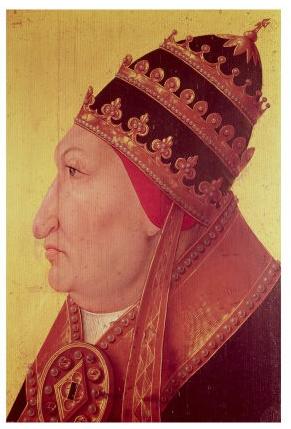
The Borgia Pope as he was, not as Jeremy Irons played him recently on TV


Visit the author's website.


This review is by Candida Martinelli, of Candida Martinelli's Italophile Site, and the author of the cozy-murder-mystery novel AN EXTRA VIRGIN PRESSING MURDER, and the young-adult/adult mystery novel series THE VIOLET STRANGE MYSTERIES the first book of which is VIOLET'S PROBLEM.